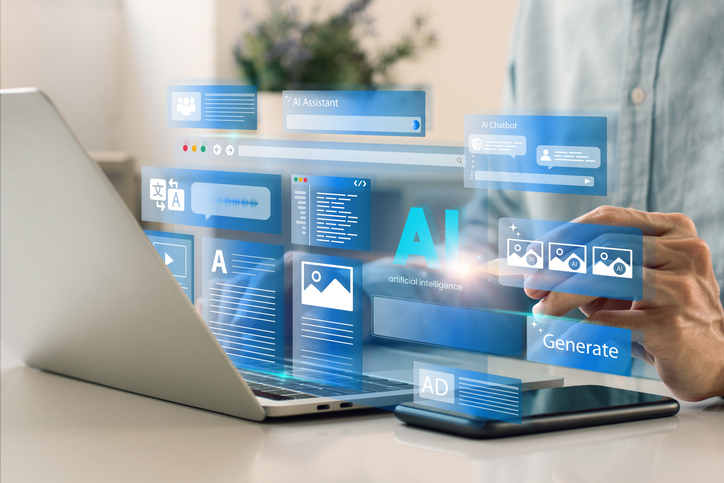
Back in 2014, Stephen Hawking told the BBC “The development of full artificial intelligence could spell the end of the human race”. This was said in the context of developments in the technology he used to communicate which, at that time, involved an early form of AI that gradually learned how he thought and predicted words that he might want to use next.
Whilst not yet at the end of the human race, AI is certainly changing many aspects of life at a rapid pace, and having a major impact on a wide variety of jobs and roles. Research in late 2025 by SEO company Graphite estimated that over 50% of online English-language articles are now generated by AI. This is an increase from around 10% in late 2022, coinciding with the release of ChatGPT.
But does this mean that all online content will soon be created by AI? And, if so, what is the future for content creators?
We believe that the “best of both” approach is the most likely way forward. With the right balance of AI and human input, your content can still be king. So in this article we explore:
- How AI can be used effectively in content creation.
- Why content creation still needs the human touch.
How AI can be used effectively in content creation
Whatever kind of content you are creating, there are definitely ways that it makes sense to use AI to smooth the process. Here are five ways you may want to do this:
-
Initial research
Research and searching for sources of information can be a very time consuming aspect of content creation, and time spent on this doesn’t necessarily correlate to the final quality of the content. So using AI to build an initial body of information is a great idea, enabling content creators to then hone in on the sources that are most promising, and check for accuracy and relevance to the content.
-
First drafts
Some content creators rely on AI to produce first drafts of articles, blogs or posts which can then be tweaked to add the human touch. Some content creators find that doing this can help to eliminate writer’s block and get things started. Whilst this strategy may seem to work for you as a content creator, it’s important to check such drafts carefully for accuracy of information and conclusions as well as change the tone to fit the brand which it represents.
-
Original image creation
AI can create original images from a simple search prompt, which can be great news if you can’t find the exact image you want to use. Just be aware that in the UK there is a bit of a grey area regarding copyright of such images. New images are created by AI from new arrangements of pixels based on patterns learned from billions of training images. There is no guarantee that some of this training data may be copyrighted which means that if AI unintentionally creates an image that closely resembles a copyrighted work, the images could infringe copyright. So if you do use AI to create images, it is worth doing a reverse image search on it just to check for close matches.
-
Website optimisation
AI can be useful to automate or partly automate some of the optimisation needed for website success. For example adding metadata and tags to text and images for SEO, and now also AEO (Answer Engine Optimization) and GEO (Generative Engine Optimization). It can also prepare summaries of content for search results and content highlights. All of these make the website more visible and accessible, and using AI for these processes will save time.
-
Personalisation
One of the great strengths that AI can bring to your content creation is that it can enable that content to be increasingly personalised to each user. By tracking and using individual user behaviour, AI can compile this data and identify patterns to predict what each user is likely to want next. This can then be used to present dynamic relevant content and make tailored product recommendations to each individual user.
Why content creation still needs the human touch
So, there is much that AI can be used for to help with various aspects of content creation. But the human touch is still very much needed. Here are five reasons why:
-
Humans bring the benefit of years of experience
Despite the vast search and data collation capabilities of AI, human content creators bring years of experience. Not just of content creation but of life itself. That experience and accompanying factors such as empathy, intuition and hunches, bring so much indefinable wealth and depth to content creation.
Also, flipping this round to the content creators themselves, by keeping them as content creators and offering career development and progression paths we are investing in the wellbeing and success of people and the future of the human race.
-
To eliminate the risk of misleading errors
We referred to this earlier, but AI is not immune from errors. AI content generators are subject to what is termed “hallucinations” ie either misleading answers or unrealistic images. Because AI systems are not yet able to assess whether their outputs are true, a hallucination can occur when they output data that seems feasible but is actually incorrect or factually false.
Unless content is factually checked by humans, it has the potential to mislead and also lead to reputational damage.
-
To maintain brand credibility and voice
The term “AI slop” has hit the headlines recently. It has been used particularly to refer to fake videos and pictures on social media, but also embraces the huge quantities of AI-generated content on the Internet as a whole. And a backlash is brewing. Many users are becoming weary of digital noise, some describing themselves as having digital fatigue. One of the biggest culprits in this is AI-generated content that can be bland and lack personality.
To ensure that your content stands out from the crowd is consistent with your brand credibility, reputation and voice, it needs to be created and curated by humans.
-
To ensure compliance with AI labelling
In the UK, there is currently no legislation requiring AI-generated content to be labelled, but in some areas of the globe – such as China and California – this does exist. AI labelling requires it to be marked as being AI-generated so users know the content’s origin.
The EU AI Act came into force in 2024 and is expected to be fully implemented later in 2026 or early 2027. At this point, UK businesses serving the EU will need to comply.
It remains to be seen as to whether similar legislation will at some point be introduced for all UK online content, but it would seem to be a likely future option. So having a good proportion of human content creators – particularly in light of the growing disillusionment caused by digital fatigue – has got to be a good thing.
-
Humans are more environmentally-friendly
Another, often overlooked, good reason for human content creators is that they are more environmentally-friendly than AI. AI has a huge impact on the environment, particularly generative AI and its use of data centres. Goldman Sachs recently forecast that AI’s slice of the overall data centre market will double to 30% over the next two years, and data centre occupancy is likely to be at 93% by the end of 2026. Each data centre not only generates carbon emissions but also needs huge amounts of water for cooling which can disrupt local water supplies.
So by maintaining human content creators as well as using AI wisely, your digital marketing agency is doing its part to support the environment.
In this article we have explored how AI can be used effectively in content creation, and why content creation still needs the human touch. We hope it has provided food for thought.
We leave you with these appropriate closing words from Ginni Rometty, the former CEO of IBM. She is renowned for advocating that AI should be viewed as a tool for collaboration rather than a replacement for humans. In her words:
“AI will not replace humans, but those who use AI will replace those who don’t.”